

Stakeholder Engagement: A Key Ingredient to Project Success
Recently, I had the privilege of facilitating a workshop focusing on project management fundamentals as part of the British Columbia Institute of Technology’s (BCIT) Corporate and Industry training within BCIT’s School of Business + Media. The workshop covered off many key aspects of project management, but the topic of stakeholders and stakeholder engagement was a common theme throughout.
In practice, particularly within the profession of project management, the approach to managing stakeholders focuses on addressing the expectations and requirements of all internal and external stakeholders that are involved with a project. As well, as a general principle, stakeholder identification and management should be addressed early on in your project in order to build appropriate project communications that relate to overall engagement.
The Clarkson Principles of Stakeholder Management provides you with guidelines on how to effectively engage with stakeholders. This article outlines these principles but takes things one step further by providing some effective tactics and approaches that have contributed to overall project success.
When kicking off a new project, it should be noted that stakeholder engagement and management should first follow three simple steps, prior to employing the Clarkson Principles and developing tactics on how to engage. These steps are:
- Identify your stakeholders
- Assess and analyze their power/influence and interest
- Develop engagement tactics for ensuring you address their unique needs and interests
Below is a diagram of an assessment tool you can use to identify and document your stakeholders and their level of power and interest.
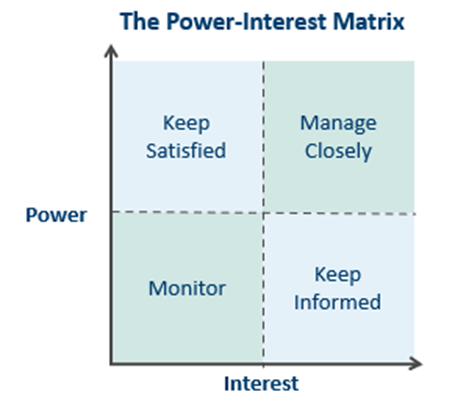
Once this is done, you can then apply the Clarkson Principles of Stakeholder Management, which are:
- Acknowledge and actively monitor interests and concerns of all stakeholders
- Listen to and openly communicate concerns with stakeholders
- Adopt processes and modes of behaviour that are sensitive to the concerns of the stakeholder groups
- Recognize the interdependence of efforts and rewards
- Work cooperatively with all stakeholder groups
- Avoid activities that may cause stakeholder conflict(s)
- Acknowledge and address and conflicts
As for the tried-and-tested tactics around these principles, read on:
Acknowledgement and active monitoring
One of the first steps in developing your stakeholder management plan, once you have identified who your stakeholders are, is identifying and then acknowledging their needs and actively checking in on those needs. One tactic that has worked on our projects is developing a stakeholder register and logging each stakeholder’s name, role, needs and level of interest and power or influence. Tracking this register on an ongoing basis will assist you in the active monitoring principle. Establishing a set cadence for monitoring is recommended. Depending on the duration of your project, the cadence and frequency can be adjusted up or down as desired (e.g., for a longer-term project, perhaps a monthly review and check-in will suffice).
Listening to and openly communicating
Actively listening to and openly communicating with stakeholders makes them feel heard. One tactic that has worked on past projects is practicing active listening by making the right space for the moment. In some cases, stakeholders will need to be heard more than once – in fact – they may need to be heard repeatedly! Don’t rest on your laurels – check in as often as you can. In some cases, the check-in will not be needed; in others, it will be a great opportunity to listen and communicate in an open way.
Adopting processes that speak to specific needs and concerns
Adopting specific processes to speak to and address the unique needs of our stakeholders is the heart of being an accessible and equitable leader. By meeting stakeholders where they are, you intently bridge the potential gap (or gaps) in understanding and create opportunities for stakeholders to truly feel heard. I’ve worked in teams where I’ve needed to adjust my communication style or reporting cadence to ensure stakeholders needs were being addressed. I have found that a tailored approach to specific needs and in the spirit of achieving outcomes made all the difference.
Work cooperatively with all!
The philosophy of working cooperatively is not a new concept, and from the classroom to the boardroom, there is always some need for consensus-building and collaborative approaches required. Specifically, when we work to support the blending of the unique strengths of each individual stakeholder, in particular to produce results, we can focus on ensuring everyone has an opportunity to contribute and isn’t sidelined.
Specifically, some ways in which you can drive collaboration and keep it rolling include:
- Using the right tools for the specific scenario(s) you find yourselves in. One example, when working remotely, or in a distributed environment, is using Slack’s integrations to connect Outlook and Zoom, can save time and ensure you’re connected where and when needed.
- Keeping everyone on the same page (this relates directly to principle #2: listen to and openly communicate). As discussed, developing the rigor to ensure ongoing communication is happening and is relevant will boost collaboration amongst stakeholders.
Avoid conflict-causing activities and Acknowledge and address conflicts
A few ways in which we have addressed conflict in stakeholder management and engagement include, as above, addressing conflicts early (or mapping possible ones out to head them off at the pass!), looking for relationships between issues (sometimes there’s a root cause that can cause more than one conflict) and, if needed, using multiple routes and forms of communication.
By applying these principles, project managers, and business leaders in general, will build a solid foundation for managing stakeholder relationships within their projects. Through a collaborative and balanced approach, our hope is that all stakeholders will collectively work to improve the likelihood of project success.
 Bichon Associates